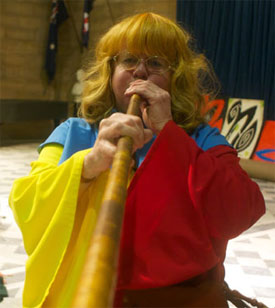
 Left - Winsome Evans. Photos - Wayne Richmond
Given the wintry scheduling, it might as well be called the Runnynose Pop Festival, but Runnymede 33 seems at least vaguely appropriate: I think some document or other was once signed and sealed there, by one King John, circa 1215.
That, of course, predates the charter implied by the name Renaissance Players, the ensemble that, each year, unfailingly and unflinchingly presents an entertaining new programme of chartbusters from the middle ages, under the evocative, if temporally askew auspices of the Runnymede Pop Festival. In any case, the Plyers' fearless leader, Winsome Evans, would be apoplectic if I were to insist on historical literalism: the point of the name is to locate their aspirations approximately; it's more about the idea of rebirth and reinvigoration.
The sense of fun and humour embodied in the brand is indicative of the concerts themselves, held, somewhat ironically, in the pompously grandiose gothic splendour of Sydney Uni's Great Hall, presided over by sombre, expired chancellors, captured on canvas, looking down their learned noses in definitive condescension.
Of course, the renaissance was something to be celebrated. Just as, in our own time, we revel in the mastery, erudition, not to mention clowning, of Abbott, or Costello, that bygone period had its own modest celebrities: da Vinci, Michelangelo, Machiavelli, et al. And just as an Abbott might pin his pricked-up ears to Britney, or Beyonce, it's an odds-on bet Leo would've had a liking for the laude; Michelangelo, the madrigal.
The RP have been making a public spectacle of themselves since 1967, making them only 5 years younger than The Strolling Bones. But the Players' psychedelic getups easily outstrip the former Carnaby Street cultivations of the Stones. More importantly, their performance art is every bit as much of a trip: a fusion of medieval music, poetry and dance.
This year's festival is circular; which is to say Winsome has taken the circle as a motif around which to structure what proves to be a lively 'menu'. The theme alludes to the dance-ring, a central facet of cultural expression in the middle ages (if not yours, history's), but also to various forms relative to that shape, such as the rondeau. The significance of the circle in medieval times, as an echo of cosmological movements, resonating with all the mystery, magic and awe those imply, can hardly be overestimated; dance was encouraged and seen as something sacred, in the sense that holding hands mimicked the union of elements.
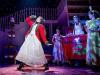
Ad Honorem Tui Christe opens the bidding, in a reverent way that seems particularly redolent, given the cathedral-like space in which the Players strut their stuff. The melody has been excerpted from Beauvais' Ludus Danielis, or Play Of Daniel, a high liturgical drama considered to be one of the richest examples of that genre; yet there's nothing stuffy, dry, heavy or brooding about it. Some poetic licence re the text has been assumed, in order to appropriate a little more relativity to the 21C audience. A key facilitator of this is mild-mannered, erstwhile publicist Geoff Sirmai, who hides many bright lights under his smooth-pated bushel, not least as a very considerable comic actor. He does more than merely read poetry: he performs and enlivens it, dressed in full, ridiculous regalia; he cracketh a merry, naughty note. The poems that comprise the text of Carl Orff's Carmina Burana are much drawn upon, alongside other surprisingly bawdy, bodice-ripping yarns of aching yearns. Titles like 'Jankin, The Clerical Seducer' betray the MA15+ tone.
Most all the Players make vocal offerings, the foremost contributors being soprano, Sussanah Lawengren and mezzo, Laura Medway, who float like angels in the ample headroom afforded by the steeply-vaulted rafters high above. They also dabble diligently in rustic percussion.
Tony Lewis taps, beats and bangs all manner of unpronounceables: darabukka; daireh; tapan; bombo. Until now, I thought Bombo was a blip on the map, just this side of Kiama, but I learn it's an Argentine drum, fashioned from a hollowed tree-trunk and adorned with cured animal skin; cow, goat, or sheep, depending what you have in the backyard.
Internationally-renowned 'world' musician Llew Kiek, on an assortment of exotic stringed things, needs little or no introduction. Ud, diwan saz, chitarra moresca and gittern are all well within his province. A cousin of the lute, the ud's appearance may be pear-shaped, but Kiek's playing is anything but: no level of complexity seems to even touch the sides of his cool expertise.
Jehan Kanga is a gifted baritone as well as instrumentalist. In the latter realm, his weapons of choice include vielle, rebec, daireh zils and the humble, if grossly underestimated, tambourine. The vielle is a predecessor of the violin, as its name implies: imagine a woman without a waist and you've an idea of the differential in appearance. Bronwyn Bishop, as against Kylie Minogue. It also has another string to bow.
Adjacent, on vielle and rebec, Matthew Greco excels as both soloist and team-player. He appears thoroughly absorbed, clearly enchanted and completely at ease; always a pleasure to observe in a musician.
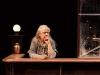
Finally, the irrepressible scholar and hands-on early music enthusiast, Ms Evans, fascinates with her treasure-trove of arcane implements: treble and alto shawms; doucaine; whistle; lur; gemshorn; sinfonye; harp; psaltery; organetto. The last, for example, is just like an organ (not a kidney, or liver, but the musical type), only smaller. Much. So much, it can be carried strapped to the shoulder, if so desired.
Attired like a trouble of court jesters and demure damsels, attended by their cache of curiosities and transfixing with their maypolar musical excursions, the Renaissance Players' 33rd Runnymede Pop Festival may not offer the free love and hallucinogenic herbs of Monterey, but it does embody a free, adventurous spirit. Me thinketh it does me good.
It's about the most fun you can have while keeping your kirtle on.
RENAISSANCE PLAYERS
33rd Runnymede Pop Festival
Venue: Great Hall | University of Sydney
Dates: Tuesday 8th and Wednesday 9th June, 2010
Time: 7pm
Tickets: $30
Bookings: at the door | 1300 306 776 | www.mca-tix.com.au